Church Overview
This simple rectangular hall church, with its Gothic windows and buttresses, was built originally for the United Free Church of Scotland by the local architect Alexander Cumming Dewar. Opening as St David’s United Free Church on the 8th July 1926, it was praised in one local newspaper at the time as “the most important addition to the architectural amenities of the district.”
Built of Newbigging stone, it cost £5000 to build, with the funds raised by the congregation, and it replaced the adjacent Free Church of Scotland Mission Hall, built 1884-85, which was then converted for use as a church hall. Inside, it retained throughout its time as a place of worship its original Oregon pine pews, which could accommodate up to 400, and boarded timber dado panels, beneath a lofty open-beamed timber ceiling. Its handsome pulpit was situated in the centre of the rear gable, with a window above and a carved communion table, lectern, font, minister’s and elders’ chairs in front.
Following the Union of the United Free Church and the Church of Scotland in 1929, the building passed into the care of the Church of Scotland. Its congregation united with that of Milton of Balgonie Church in 1956 and then Windygate and Balogonie Churches united with Kennoway Church in 1997. The following year, the combined congregations opted to to name the new cluster after St Kenneth, a contemporary of St Columba who is said to have brought Christianity to many corners of Fife in the 6th century.
The little church was closed in 2022, due to safety concerns with the building, and, although it was subsequently repaired, it did not reopen again for regular public worship. The decision was taken by the Church of Scotland, during a period of rationalisation of its nationwide property portfolio by the denomination, to sell the church and its adjacent hall to a private owner in March 2025, just short of its centenary.
Closed and now in private ownership
Image Gallery
Click image to open gallery.
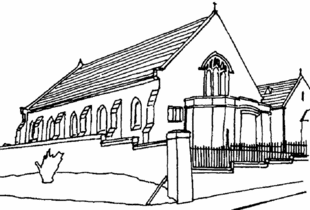
St Kenneth's Parish Church, Windygates
Disclaimer
The information about churches in Scotland’s Churches Scheme has been provided by the congregations or taken from the Historic Scotland list and published sources, in particular, the Buildings of Scotland volumes and the RIAS Illustrated Architectural Guides. To contact this specific church please complete the Contact this Church form above. The information is not authoritative; please contact Scotland’s Churches Trust to let us know of any errors or omissions.