
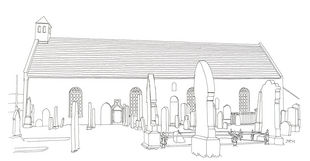
St Peter's Kirk, South Ronaldsay
Denomination: Former Church of Scotland, now owned by Historic Churches Scotland and managed by the Friends of St Peter’s Kirk
Address: Eastside, South Ronaldsay, KW17 2TJ
Local Authority: Orkney
Listing: A
Church Facebook Page
Church Overview
Formerly the “North Parish Church” for the island of South Ronaldsay and sometimes known as the Peterkirk, the present oblong harled building, is thought to have been first constructed in 1642, most likely on the site of an earlier church, and then substantially renovated in 1801 after the building had fallen out of use and become roofless in 1793. Consisting of four bays, with a round-arched window and small bellcote on its south west gable and a 19th century porch and vestry added to its south west gable, its roughcast harl and graded Orkney slate roof ensure visitors are left in no doubt of its long cherished place in the island’s landscape.
The early 19th century interior is relatively intact, a rare survivor these days, and features a pulpit with sounding board on the long wall and a long central communion table (believed to be unique in Orkney and increasingly rare in Scotland). The central box pew, once reserved for the use of the elders of the kirk session, is also worthy of note. All of the pews in the sanctuary are believed to have been crafted from driftwood or materials salvaged from wrecked vessels, as spare timber on the islands was always a scarce commodity.
Significant refurbishment works were undertaken in 1967, overseen by the architect John Wilson Paterson with input from the noted Orcadian artist and royal limner Sir Stanley Cursiter. The entire restoration attempted to retain as many original features and furnishings as possible, which may be when the 19th century oil lamps were converted to electricity, and saw the refreshing of its original colour scheme. Not long after the completion of the careful restoration, the well-known lover of churches and celebrated poet Sir John Betjeman visited St Peter’s in 1970 and, despite his famed fond preference for traditional Anglican church buildings, was apparently nonetheless delighted by its attractive and peaceful traditional Presbyterian interior.
The historic island kirk was threatened with closure in 2020 as its owners, the Church of Scotland, embarked upon a nationwide rationalisation of its property portfolio. A local group of residents formed the Friends of St Peter’s Kirk SCIO and struck up a partnership with the national heritage charity, Historic Churches Scotland. The latter purchased the church from the General Trustees of the Church of Scotland for £1 in the autumn of 2021 and the community group now oversee the day-to-management of the building, continuing to hold occasional services and operating it as a hub for local cultural events.
A number of repairs and renovations have been carried out by the Friends since taking on the historic church, including repointing the eroded exterior mortar and replacing rainwater goods. The external works also included the restoration of the church bell, which had been silent for decades and hidden in the belfry behind generations of nesting materials. Once uncovered it was found to be inscribed with “The Hope – 1771”, raising further questions about its origins. You can listen to the story of its rediscovery and repair in this piece for BBC Radio Scotland.
The church is surrounded by an ancient graveyard that contains many interesting memorials, including a remarkable headstone, designed to look like a sinking ship, marking the final resting place of two sailors who were lost in the tragic 1937 sinking of the Finnish ship the Johanna Thorden. A rare incised Pictish symbol stone was discovered built into the church walls during the 19th century and is now on permanent display in the Early People Gallery in the National Museum of Scotland in Edinburgh. A copy of this ancient stone can now be seen hanging in the church.
The artist Sheena Graham-George has created this Listening Walk that guides visitors around the kirk and its immediate locality, interweaving accounts of the building and its history from local residents.
Services
On occasion
Opening Arrangements
Open by arrangement

Image Gallery
Click image to open gallery.
St Peter's, South Ronaldsay
Disclaimer
The information about churches in Scotland’s Churches Scheme has been provided by the congregations or taken from the Historic Scotland list and published sources, in particular, the Buildings of Scotland volumes and the RIAS Illustrated Architectural Guides. To contact this specific church please complete the Contact this Church form above. The information is not authoritative; please contact Scotland’s Churches Trust to let us know of any errors or omissions.