
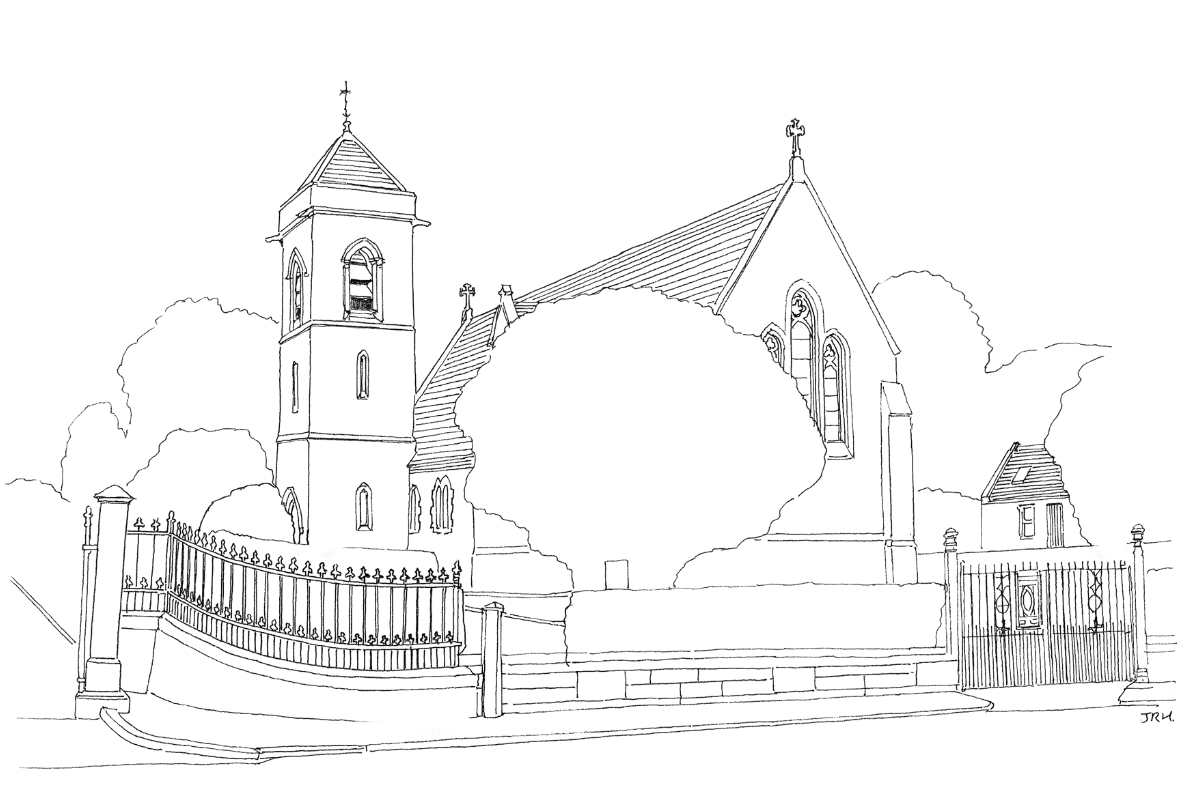
Holy Trinity, Keith
Denomination: Scottish Episcopal
Address: Seafield Avenue, Keith, AB55 5BS
Local Authority: Aberdeenshire
Listing: B
WEBSITE
Church Overview
Holy Trinity in Keith traces its history back to to 1688-89 when the local clergyman, the Rev James Thornton, was ‘deprived of his benefice’ due to his ‘strong Episcopalian’ principles. In 1779, the local Episcopal congregation used a simple two-roomed cottage in Keith as their meeting house, before building a small chapel in 1807, which was eventually consecrated in 1832.
The present Gothic, cruciform church, with its three-stage tower set back from the road, was built 1882-83 to designs of the prominent Scottish architect Alexander Ross. The stone came from local quarries and Covesea, near Lossiemouth, and the nave and chancel have an open timber Mansard roof, with its principle beams supported on projecting stone corbels. The sanctuary is lit by some lovely stained and coloured glass, including a three light window above the altar installed in 1896 that depicts Christ at the Good Shepherd in the centre, flanked on either side by Moses and St Paul.
Holy Trinity has an interesting link with the American Episcopal Church in the ‘Seabury Chair’ on which Bishop Robert Kilgour (Bishop of Aberdeen 1768-86) sat when consecrating Bishop Samuel Seabury on 1784 as the first Bishop of the American Episcopal Church. The church also houses an historic table that was used as an altar locally during the period when Episcopalian forms of worship was severely curtailed in Scotland.
Today Holy Trinity in Keith sits in some extensive, well-tended grounds, in the heart of the town and is linked with St Michael’s, Dufftown; Gordon Chapel, Fochabers; Christ Church, Huntly and St Marnan’s, Aberchirder as part of the Isla Spey Deveron Group of Scottish Episcopal Churches.
Services
Sundays at 11.30am and 4th Thursday of the month at 11am
Opening Arrangements
Open by arrangement
Image Gallery
Click image to open gallery.
Holy Trinity, Keith
Disclaimer
The information about churches in Scotland’s Churches Scheme has been provided by the congregations or taken from the Historic Scotland list and published sources, in particular, the Buildings of Scotland volumes and the RIAS Illustrated Architectural Guides. To contact this specific church please complete the Contact this Church form above. The information is not authoritative; please contact Scotland’s Churches Trust to let us know of any errors or omissions.